Four Percent: The Hypertension Number Kenya Can’t Afford to Ignore
There is a number buried in Kenya’s National NCD Strategic Plan that deserves far more attention than it gets.
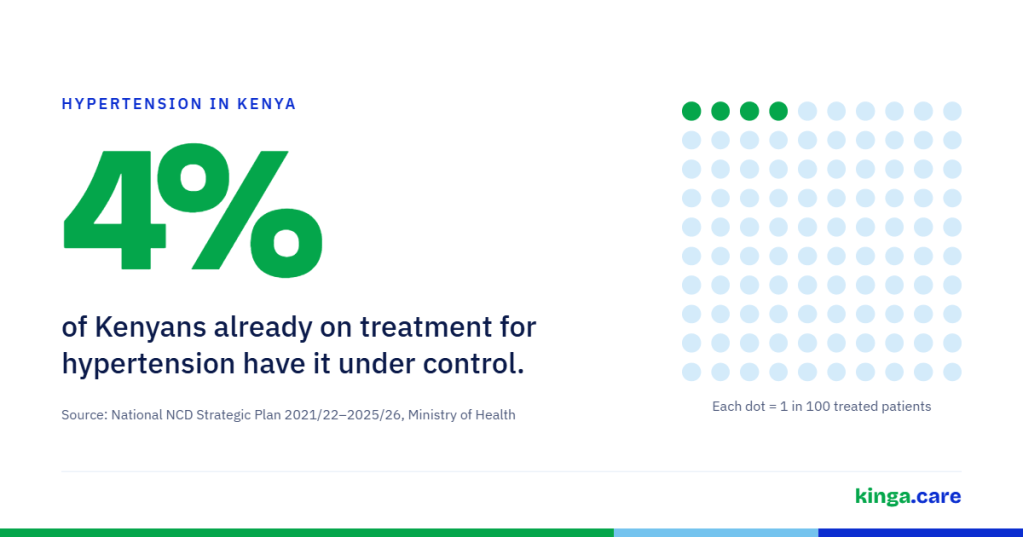
Close to a quarter of Kenyan adults live with hypertension. That alone is sobering. But the figure that should stop us in our tracks is this one: of those already on treatment, only 4% have their blood pressure under control.
Read that again
This isn’t 4% of people who’ve never been diagnosed. It isn’t 4% of people who never made it to a health facility. It’s 4% of the people who did everything we asked of them.
They got tested. They received a diagnosis. They started treatment.
And for 96 out of every 100 of them, it still wasn’t enough.
The story we usually tell
When we talk about non-communicable diseases in Kenya, we tend to frame the challenge as one of access. There aren’t enough clinics. There aren’t enough specialists. Diagnostics are too scarce, too expensive, or too far away.
Those gaps are real, and they matter. Closing them is essential work.
But the 4% figure tells a different story. It describes people who reached the health system, and were still failed by it.
Where the failure actually happens
The breakdown doesn’t happen at diagnosis. It happens in the weeks and months afterwards, in the quiet, unglamorous work of managing a chronic condition over time:
- The dosage that’s never reviewed, even as the patient’s blood pressure stays stubbornly high.
- The follow-up appointment that’s never booked, so the patient drifts out of care without anyone noticing.
- The lab test nobody orders, not because anyone decided against it, but because nobody was tracking when it was due.
None of these are dramatic failures. No single one makes headlines. But together, they explain how a patient can be “in the system” and still be effectively unmanaged.
Access is the beginning, not the end
Hypertension isn’t a condition you treat once. It’s one you manage for years, often for life. That requires something our health system is less built for: continuity. Someone, or something, needs to remember that this patient exists, know where they are in their care, and act when the next step falls due.
Access gets a patient into the system once.
Something else has to keep them in it.
If we want to move that 4% figure, building more facilities won’t be enough on its own. We also need to invest in what happens after the first visit: follow-up, tracking, and the steady attention that turns a diagnosis into actual control.
Source: National NCD Strategic Plan 2021/22–2025/26, Ministry of Health, Kenya.
